


The Coastal and Marine Ecological Classification Standard (CMECS) is a catalog of terms and definitions used to describe and classify marine ecological data using a simple, standard format, and common terminology. CMECS allows users to organize and interpret marine observational data for GIS applications using a collection of aquatic and biogeographic settings and biotic, water column, substrate, and geoform components.
More information about CMECS, including technical guidance and examples of how to apply the standard, is available at the NOAA Integrated Ocean and Coastal Mapping Coordination Team’s website.
About
CMECS can be used for a wide variety mapping and research needs. There are many ways to use the framework.
The CMECS in Action interactive map shows the locations of a growing collection of projects across U.S estuarine, marine, and Great Lakes waters. The map includes information about the project, the settings and components used, and links to project resources and data where available.
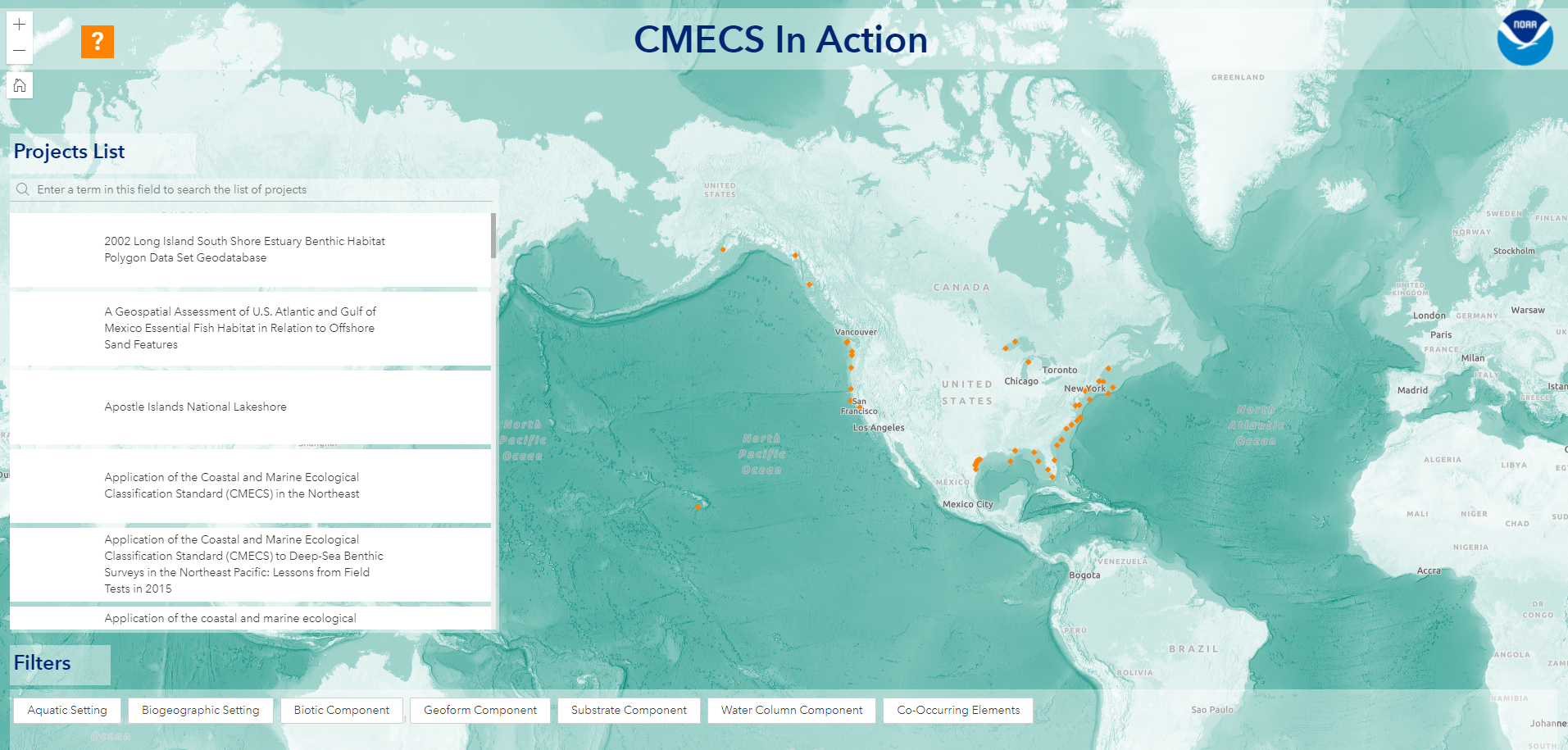
All the information displayed in the application is also available in this accessible, 508-compliant table.
Email ocm.cmecs-ig@noaa.gov with your project information so we can share it with others.
Federal Geographic Data Committee (FGDC)
CMECS was endorsed by the Federal Geographic Data Committee (FGDC) in 2012 as a national ecological classification standard. The FGDC encourages the use of standards to promote discovery, use, and share data and recommends use of their endorsed standards in all federally-funded work.
The CMECS Catalog
The CMECS Catalog is the definitive collection of ecological units and classification framework. The Catalog contains all units that are or have been members of the CMECS classification throughout its lifecycle. The catalog also includes unit annotations that promote Findability, Accessibility, Interoperability, and Reuse (FAIR) principles.
The CMECS Catalog was transformed from its original format (see: Legacy Resources below) into Extensible Markup Language (XML) Resource Description Framework (RDF) and Web Ontology Language (OWL). The CMECS Catalog is stored and managed in a GitHub repository where all versions and documentation can be viewed and downloaded.
CMECS Catalog GitHub
A repository for viewing and downloading CMECS Catalog releases and documentation.
CMECS Thesaurus
The latest version of CMECS ecological units listed in hierarchical order.
Browse and search CMECS
A web interface for browsing and searching CMECS on the Ecoportal Ontology Registry.
Additional Information
Coastal and Marine Ecological Classification Standard Document
The CMECS document (FGDC-STD-018-2012) contains the CMECS ecological unit terms and definitions at the time of publication, along with scientific context, implementation guidance, examples and illustrations.
While the ecological unit lists in this publication have been updated, the underlying scientific principles and framework that provide important context for CMECS implementation remain relevant and sound. For an up-to-date list of ecological units, please refer to the CMECS Catalog and CMECS Thesaurus.
Legacy Resources
CMECS Catalog of Units Database
A database developed by Nature Serve that contains the CMECS ecological units and framework as published in the FGDC-STD-018-2012 CMECS document.
This database is superseded by the current CMECS Catalog.
CMECS Codeset
This workbook contains the CMECS Units and Codeset, organized in the CMECS component and settings framework.
These codes have been added into the current CMECS Catalog.
Coding System Approach for CMECS Classification and Modifier Units
A user guide for the CMECS Codeset that includes an explanation of the codeset structure, examples, and other useful documentation.
Dynamic Standard Process (DSP)
CMECS was designed to be updated to reflect advances in scientific knowledge, technology, and the needs of coastal management communities. The CMECS Implementation Group (IG) oversees the Dynamic Content Process (DSP), which was created to gather and assess change proposals and suggested revisions from the user community (see figure).
Examples of proposed changes include:
- Minor edits, including corrections of typographical errors, spelling, grammar, punctuation, and clarifications of meaning
- Addition, removal, or significant modification of ecological units, including provisional units*
- Major changes, such as structural changes that alter the hierarchical arrangement of units
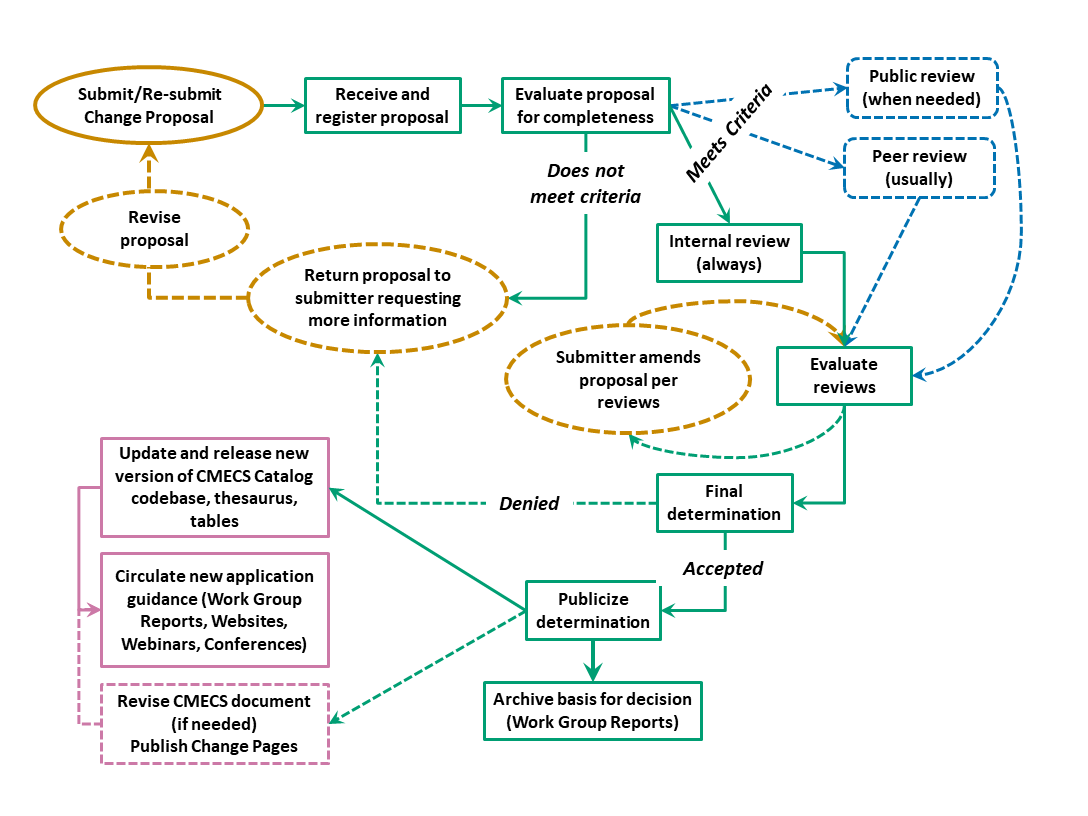
The DSP outlines various review pathways, each tailored to the type of change being proposed. Regardless of the specific pathway, the DSP will always:
- Provide clear criteria and requirements for proposing and evaluating changes
- Engage subject-matter experts in reviews when necessary
- Maintain open communication with proposers throughout the process
- Ensure the publication and open access of all CMECS versions and documentation throughout its lifecycle
Questions about the CMECS update and the DSP can be sent to ocm.cmecs-ig@noaa.gov
* Provisional units are ecological units that have been defined and used by a practitioner to describe a feature in their study area that is not currently in CMECS. These ad hoc units should fit in the existing CMECS hierarchy. They may be used where there is no existing CMECS unit, or where the provisional unit provides a better description of the feature. Provisional units are most likely to occur in the Geoform component as new geoforms or in the Biotic component as new biotic communities.
Who can propose changes to CMECS?
Anyone can propose changes to CMECS. The majority of proposals are expected to come from experienced CMECS users who have identified gaps or inconsistencies in the standard. For example, practitioners might seek formal inclusion of provisional units used in their work. Change proposals can also address minor revisions, such as grammatical fixes, typographical corrections, and improvements to definitions and clarity.
Proposing CMECS Revisions
Requests for formal changes or addition of new units should be submitted through the Proposed Change Request Form. The DSP proposal review workflow followed by the CMECS IG is outlined in this figure.
Please read the following guidance documents before submitting a change proposal:
- CMECS Proposal Submission Guidelines
- Criteria for the Review of Revisions to CMECS
- CMECS Peer-Review Guidelines
Contact
Contact the CMECS IG (ocm.cmecs-ig@noaa.gov) at any time to discuss your proposal prior to submitting.


